
Solar Hot Water Systems.Gas Boosted Solar.
Hot Water Delivery Temperature
How Do Solar Hot Water Systems Work?
Now let’s see how a typical hot water system works. First we’ll go into solar panel based hot water systems.
Solar Panel Hot Water Systems
Here’s a very simplified diagram that explains the 3 main components of any solar panel based solar hot water system: The panel, the storage tank and the boost.

Let’s go through the diagram:
1. Cold Water at mains pressure enters the solar panel. The panel is designed to absorb the sun’s heat and transfer it to the water as efficiently as possible.
2. The sun heats up the water, how much by depends on the strength of the sun at that moment in time.
3. The hot water moves to a hot water storage tank. As the hot water comes in it pushes colder water to the bottom of the tank (because hot water rises, so cold water must drop) where its only option is to go back into the solar panel to get hotter. As this cycle repeats the water in the tank will get hotter and hotter until it reaches the system’s design temperature.
4. If the sun isn’t strong enough to get the water in the tank to the desired temperature (usually 55 to 60 degrees Celsius) then an electric or gas booster will kick in to add the extra heat required.
That’s it!
What size solar hot water system do you need?
Obviously this will depend on how much hot water your family uses in a typical day.
If you use more water than your solar panels are designed to heat – then your gas water heater ( Gas Geyser ) booster will kick in to give you the extra hot water you require.
Efficiency First
As with all Renewable Energy projects, you should always invest in efficiency before investing in generation. For every rand you spend on reducing water usage, you will typically save at least R5 in solar hot water hardware.
So make sure that you install good quality low flow shower heads. The good ones feel as good as high flow ones by injecting air into the stream of water.
Also invest in the most water (and energy) efficient dishwasher and washing machine you can afford. Also make sure you get a machine with a hot water inlet. Otherwise, you will just be heating cold water inside the machine with dirty old electricity!
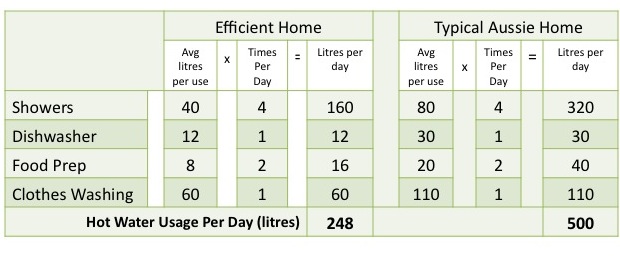
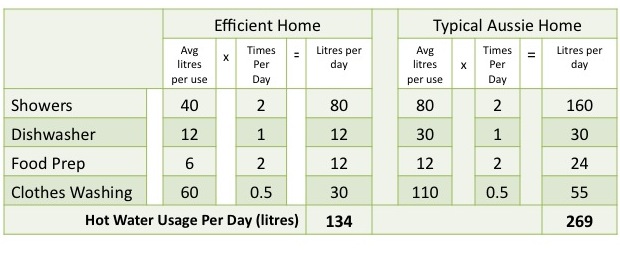
Here’s a table that breaks down the hot water use for a typical Aussie household (just click on the bars underneath to change household size):
Family of 3-4
Family of 1-2
Family of 5-6
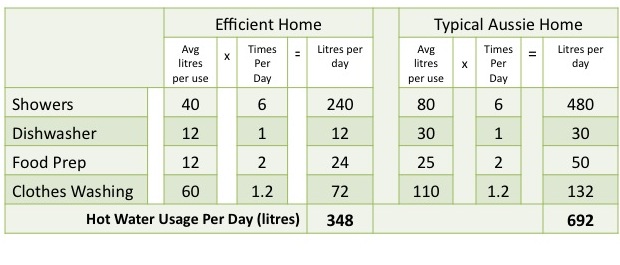
As you can see, by investing in water efficient shower heads, taps and appliances, you can quite easily cut your hot water use by almost half. Which means you will only need a solar hot water system half the size.
As a rule of thumb, a relatively water efficient household is looking at a system size of 75 litres per person. A typical solar hot water panel is 2 square metres and will supply 150 litres. So a typical 4 person family will need a system sized at 300 litres which has 2 panels.
Having said that, many 4 person households who are very water efficient get by just fine with a 150 litre system with 1 panel. At the end of the day a good installer will look at your usage and advise you exactly what size to go for.
The 3 Types of Solar Hot Water
There are 3 types of solar hot water system to choose from:
Flat plate collector hot water systems

These are the most widely used used type of collector for domestic solar water heating. Flat plate collectors are shallow rectangular boxes with glass lids and usually aluminium for the body. Typically 1-1.5 meters wide by 2-2.5 metres long.

OK, so we’ve got a shallow aluminium box, on top of which will go a glass lid. Directly underneath the glass are placed copper pipes. These copper pipes carry the water through the collector and absorb the sun’s heat. A typical pattern of piping is shown here:

Now if we put these pipes in the box as they are, they will get our water hot, but they won’t be very efficient. In order to capture as much sun as possible, we want to maximise the surface area of the pipes that is exposed to the sun.
We do this by welding horizontal fins between the pipes.
Then we put some insulation in the bottom of the box to make sure the heat goes into the water, not through the panel and into our roof, and lay the copper assembly onto the insulation. We might paint the copper black so it absorbs even more heat, then pop the toughened glass on top and voila, there’s out flat panel solar hot water collector.
Here’s a cutaway of the finished panel:

And here’s the finished thing in all it’s glory:

As you can see, these are fairly simple devices which means that they are relatively cheap to manufacture and very reliable. They are also incredibly tough. A good flat plate collector would probably withstand a thermonuclear war (so at least the cockroaches could have a hot bath).
This (apart from the cockroach bit) probably explains their popularity in Australia.
The alternative to a flat plate collector is the evacuated glass tube collector. If you thought the Holden / Ford rivalry was bad – you want to see the evac tube / flat plate fans argue about which is best! I’ll just present the facts and let you decide, dear reader!
Evacuated Tube Solar Hot Water Systems
Whilst flat plate collectors are all pretty similar in design, construction and performance, evacuated glass tubes can vary widely in their design and performance.

Evacuated Tube Collectors collect the heat through a number of annealed glass tubes that each have their own heat-absorbing plate inside. There are loads of different designs, but the basic principle is the same for all designs. Basically each tube is like a little greenhouse that traps sunlight inside the glass tube which is used to heat either the water directly, or a special heat transfer fluid that transfers the heat to the water.

The name comes from the fact that a vacuum (which is an excellent insulator) is created during manufacturing between the outer and inner glass tubes, this makes for a very efficient solar heater. And the fact that the tubes are round, not flat, means that they can efficiently collect heat no matter where in the sky the sun is. In contrast a flat plate collector is at its most efficient only when the sun is directly above the panel.
As you can imagine, these panels are quite tricky to manufacture, so they are typically more expensive than a similar quality flat plate collector. The are also more fragile, which is pretty obvious just by looking at them!
So why do people choose to pay more for an evacuated tube system?
Well the main reason is that good ones will give you more hot water in colder parts of Australia. They get more heat from the sun for a longer period of the day and their improved performance is most noticeable through the colder seasons and colder climates. This ultimately means that you will use less of your electric or gas booster if you live in those cllimates.
On top of that the round tubes are excellent at self cleaning when it rains also helping keep your system as efficient as possible.
So to sum up: you will get more solar heated hot water from an evacuated tube panel if you live in colder climes, and they look damn sexy (don’t ya think). But… you will pay more for a good one and you can’t ignore the fact that they are more fragile than a flat plate collector.
What should you go for? Flat Plate or Evacuated Tube?
To help you decide, here is a picture from the Alternative Technology Association (ATA) that shows how much of your hot water you can expect to be heated by the sun if you have a flat plate collector on your roof:
Heat Pump Solar Hot Water Systems
Heat pumps are pretty simple to understand. Get an air conditioner, run it in heating mode, and use the heat it blows out to heat a well insulated cylinder of water.
That’s all there is to it folks!
Here’s a diagram that shows the operation in a bit more detail, including how the heat is transferred to the water by compressed refrigerant that flows through a coil inside the hot water cylinder:

Now – whilst people may argue that it is not true solar, I’d say they are wrong. That’s because a heat pump transfers the heat that is already in the surrounding air and ‘pumps’ it into the water. This heat’s original source is, of course, the sun. So I’d argue that a heat pump is solar powered with an electric boost.
A heat pump is driven with electricity, but is about 5 times more efficient than a conventional ‘kettle’ style electric heater. In fact the CSIRO calculate that in some climate zones it can use less electricity over a year than a solar panel hot water system with an electric boost.
Here are the pros and cons of a heat pump system over a ‘conventional’ solar hot water system:
Pros:
- No roof mounted hardware – leaving all your roof free for Solar PV panels.
- Easy to protect from hail and storm damage
- Doesn’t require direct sunlight – so it will work in all weathers.
- No danger of overheating in summer.
- Relatively simple (i.e. about 50% cheaper!) installation than panel based systems.
- Doesn’t matter when you run them – so you can take advantage of off peak electricity tariffs
- You can power them directly from your solar electricity instead of the grid
Cons:
- The compressor can be noisy.
- Work most efficiently in warm-hot climates. i.e. they cost more to run in cold climates.
- They may use ozone-depleting CFCs in their coils.
- Lack of panels means the neighbours won’t know you have a solar powered hot water system (less green street-cred)!
When are heat pumps the better choice?
I would argue that if you have reticulated gas, live in climate zones 2 or 3 (see below), and you have plenty of unshaded north facing roof space (and don’t need it for Solar PV) and you don’t get regular heavy cloud cover, then a gas boosted panel based system is usually the more efficient and reliable option .

Heat pumps are generally a better bet in zone 1 as this zone is cloudy and typically without reticulated gas. Also panels (particularly evacuated tubes) are more vulnerable to storm and cyclone damage.
If you live in zones 3 or 4 and don’t have reticulated gas, then a heat pump will probably save you more money by heating your water more efficiently than electric boosted solar panels. The reason being that in these zones, a panel based system will typically heat only 50%-65% of your water with the sun.
A good solar heat pump in these areas should heat 65%-75% of water with the sun (when compared to a conventional electric heating element). And if you have solar PV on your roof, then a good sparky can set the heat pump up to run mostly off your solar electricity instead of the grid.
There are 3 ways to achieve this with Rinnai Continuous flow appliances.
1. Preset 60°C Appliances – The Installing Plumber Supply’s and installs an approved Tempering Valve on the hot water branch line to the bathrooms etc set at a maximum of 50°C.
This then allows for the hotter 60°C water to be supplied to the Kitchen & Laundry which is best for cutting greas and rinsing.
Whilst this requires the additional expense of a Tempering Valve , it is Rinnais preferred method of installation as it gives the end-user the best hot water solution.
2. Preset 50°C Appliances – This is where the unit is factory set to 50°C and the entire house is supplied at this temperature. This is adequate in most domestic situations, but any temperature losses in the pipe work due to poor or old insulation can
result in lower temperatures being delivered at the outlet.
This is usually noticeable in the kitchen when trying to wash dishes
with (say) 46°C or 47°C.
3. Using smaller units, install a combination of 60°C and 50°C appliances, thus ensuring that areas like kitchens and laundries
get 60°C water temperature, whilst bathrooms, ensuites and powder rooms are supplied with hot water limited to a
maximum of 50°C.
Overcoming this is to re-insulating supply lines
Living in South Africa,it only makes sense to harness the clean inexhaustible and free supply of energy The Sun.Our range of highly efficient solar hot water appliances systems help reduce your carbon footprint whilst enjoying savings.To ensure there’s all ways hot water for the those days , a gas water heater can boosted to the system. Rinnai has an extensive range of hot water systems that cater for both domestic and commercial applications.
Solar collector Installation Direction
The solar collectors should face as close as possible to North.


Tempering Valve Solar
Tempering Valve
What is a tempering valve used for?
A tempering valve is a 3-way mixing valve which is temperature actuated and used to temper a heated water supply by mixing the heated water with cold to feed heated water at a reduced temperature to the taps around your home.
What is the difference between a tempering valve and a thermostatic mixing valve?
Tempering valve vs TMV. Both valves contain a temperature sensitive element which expands or contracts in response to temperature changes in the incoming water. This expansion and contraction controls a slide valve which allows more or less hot or cold water into the mix to consistently maintain the desired temperature
Why do I need a mixing valve?
Installing thermostatic mixing valves can ensure that water is delivered at the required temperature, thereby reducing the risk of scalding accidents; it also reduces hot water consumption from a supply that is maintained at a higher temperature.
A thermostatic mixing valve (TMV) is a valve that blends hot water with cold water to ensure constant, safe shower and bath outlet temperatures, preventing scalding.
Tempering Valve. A thermostatic mixing valve (TMV) is a valve that blends hot water with cold water to ensure constant, safe shower and bath outlet …


Installation
- Valve must be fitted by a qualified plumber.
- Installation must comply with local authority requirements
- Valve must be installed in any orientation
- Flush pipes prior to fitting
- Valve must be protected by line strainer
- Connections are H (hot inlet), C (cold inlet) and OUT (mixed temperature outlet)
- Do not apply heat near the valve during installation – this may damage the mechanism.
- Do NOT install valve directly onto outlet of cylinder
- 1 m MIN copper pipe length from cylinder to tempering valve, THIS IS MANDATORY REQUIREMENT OF G12.
Hot Water Tempering Valve – Hot Water Tank Mixing Valve for Hot Water Heaters
Scalding is one of the most serious, painful and long-term injuries for young children.
Scalding can happen very quickly, depending on the temperature of the water.
Scalding Hazard
Hot Water Tempering Valve Explained – Hot Water Tank Mixing Valve
A hot water tank tempering valve maintains a high tank temperature whilst simultaneously providing more tepid water for taps. This keeps the tank hot enough to stop bacterial growth (>60°C) and provide a lower tap temperature (≈50°C) to help reduce the risk of accidental scalding.
A hot water tempering valve (hot water tank mixing valve) does this by mixing in cold water with your hot water, before it reaches your taps.
Your plumber makes the hot water temperature control valve adjustment on the hot water heater.
The tempering valve also reduces the hot water demand on the tank.
The temperature is typically controlled to within ±3%.
Tempering valves have a temperature sensitive element which adjusts the mix depending on the temperature of the incoming water flowing through the valve.
The mechanism is a sliding valve that varies the ratio of hot and cold water that is allowed to pass.
You also decrease your hot water usage by mixing cold with hot water.
Tempering Valve Regulations – Conflicting Requirements for Hot Water Heater Valve
 A hot water heater valve must help meet two different goals. The goals require the hot water heater valve to prevent scalding and dangerous bacteria growth.
The tempering valve regulations come from the Plumbing Code of Australia (PCA), which has two conflicting requirements.
To protect against the growth of Legionella bacteria, the cause of Legionnaires’ disease, it is a legal requirement that the hot water temperature control valve adjustment be set at a minimum temperature of 60°C.
Hot Water Tempering Valve & Thermostatic Mixing Valve Now Required
The PCA tempering valve regulations now requires that hot water tempering valves be installed on all new homes or renovations. So, when replacing an old hot water system, per the regulations, you must now install a tempering valve to reduce the temperature to 50°C in bathrooms.
Kitchen and laundry applications are still permitted to bypass the tempering valve and use the hot water directly from a standard electric or gas hot water tank.
Hot Water Tempering Valve Adjustment
Hot water tempering valve adjustment should only be done by your plumber. The plumber will turn the knob on the tempering valve adjustment to mix in the cold water with the hot water, until the required tap temperature is achieved.
However, before adjusting the tempering valve, you plumber will first check to make sure that the tank temperature is set to at least the required minimum.
Types of Hot Water Tempering Valves – Hot Water Tank Mixing Valves
 There are different types of hot water tank mixing valve or hot water tempering valve for hot water temperature control of different types of hot water heaters.
Blue
Green
Orange
Black

According to SANS specifications, you will need this PCV (Pressure Control
Valve) in order to control the pressure of the system as required/ indicated
by the pressure rating of the geyser;
• A PCV is also used in conjunction with proper water reticulation and pipe
sizing to establish balanced water pressure;
• The PCV forms part of the required valves with any geyser installation
(refer to SANS10254)

PCV (Pressure Control
Valve)
Dezincification resistant brass ( DR/DZR brass)
Dezincification relates to the corrosion of brass. The minimisation
of this is a critical aspect of the quality (fit for purpose) of plumbing
fittings that come into contact with water. The risk and rate of
dezincification increases with water hardness and the acidity or
alkalinity of water (away from a PH of 7).
Dezincification-resistant brass, or DZR/DR brass, is brass that is
characterised by exceptional resistance to this type of corrosion. The
resistance is achieved by adherence to exacting specifications for
chemical composition and careful process controls. All DZR brass
must pass an ISO 6509 dezincification resistance laboratory test.
In South Africa, the use of DZR brass for components of brass
plumber’s fittings come into contact with water is national law.
Building inspectors are being trained to demand the removal of
plumber’s brassware that does not conform to statutory law.