
Rinnai Avenger 25
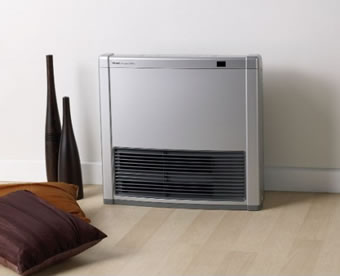
Rinnai Avenger 25
| W x H x D | = 610 x 482 x 239 |
| LPG Gas Consumption: | Low: 0,13kg/hr, High: 0,54kg/hr |
| Colours: | = White or Platinum Silver |
|
|
Please Fill out your Details And We Will Send You A Price On Rinnai Avenger 25
Rinnai Avenger 25
- Large heating capacity – up to 85m2 or a volume of 204m3
- Rinnai peace of mind safety system: oxygen depletion, flame failure and tilt switch shut down systems.
- Electronic ignition controls with a thermostat for accurate temperature control and a programmable clock timer set and forget heating.
- Quiet, high performance filtered multi-speed fan, with air outlet at floor level, provides rapid spread of warmth.
- Convenient remote control operation.
Gas Bayonet
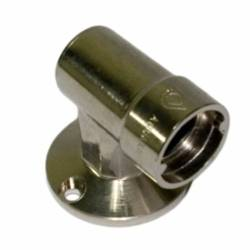
Gas Bayonet
Bayonet heaters can be moved where needed, from one room to another, as long as each room has a gas bayonet connection. This is why they are also commonly referred to as portable heaters. The heater plugs into the bayonet connection via a gas hose. This also allows you to rotate the direction of the heater to aim the heat at or away from a particular part of the room. Please see Connecting & Disconnecting Gas Bayonet Fittings Moving Home? Take it with You Bayonet heaters are much easier to take with you when you move. You simply disconnect it and go.Lower Purchase Cost Bayonet heaters cost less. When comparing like sized flued and Gas Bayonet Heaters from the same manufacturer, the flued heaters are 44% to 57% more expensive. Minimal Installation Cost If you already have a bayonet fitting in your home, there is no cost to install the heater. Even if you need to add a bayonet, the installation costs would be modest. How to Connect & Disconnect Gas Bayonet Fittings The most popular style of gas heaters in Australia are Portable Gas Bayonet Heaters. Portable gas heaters connect to your home gas supply by means of a gas bayonet fitting.The connectors consist of male and female fittings. But how do these work? What is a Gas Bayonet Fitting & How Do You Connect It?
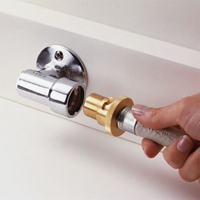
In summary:
In summary:
• A gas bayonet fitting connects a gas appliance — typically a heater — to a fixed wall or floor gas supply pipe fitting.
• The male fitting is attached to the end of the heater hose.
• The female fitting is attached to the gas supply line and affixed to the wall or floor.
• You connect a gas bayonet by pushing in and twisting clockwise to lock it in place.
• To disconnect, you push in slightly, turn anti-clockwise and then pull the male fitting out.
Read more for additional information and an important money saving tip…Female Bayonet Fitting
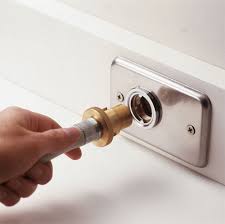
The female fittings
The female fittings are permanently attached to your wall or floor and the supply gas line is connected to it through the wall or floor. The female fittings have two locking lugs that are used to engage the male fitting and lock it in place. A rubber O-ring seals the connection. It also contains the on/off gas valve that is automatically actuated when a male fitting is fully inserted and locked. Male Bayonet Fitting